An Inconvenient Truth
What follows is adapted from Episode 3 of my Stories & Reflections podcast. For the audio version, go to the embedded player on the podcast page of this site, where you’ll also find YouTube links to the two most recent video episodes.
Three Stories, One Truth
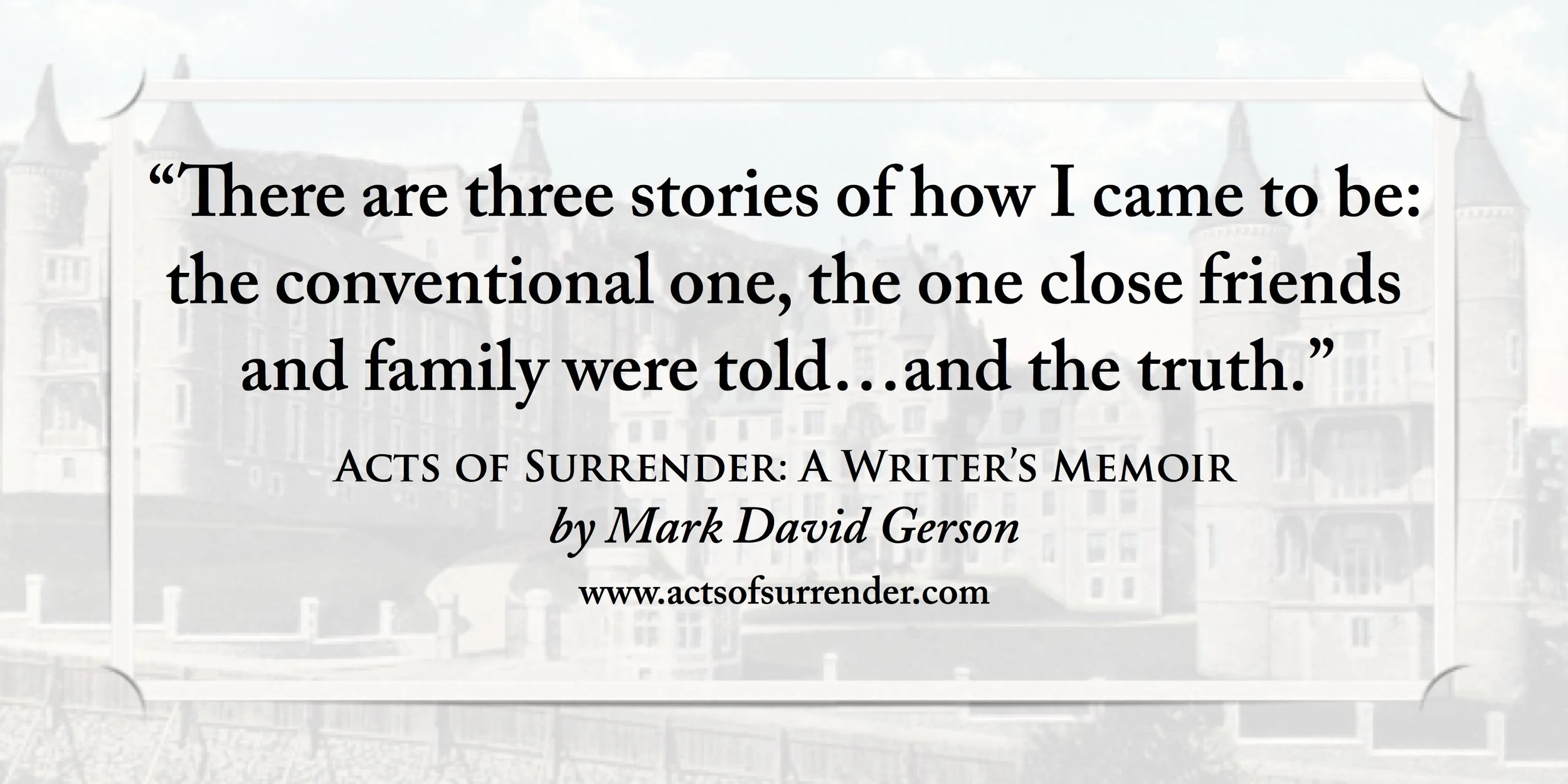
There are three stories of how I came to be, the conventional one, the one close friends and family were told, and the truth.
That’s how I start the first chapter of my Acts of Surrender memoir, as a riff on Al Gore’s 2006 documentary about global warming. Yet neither the chapter nor this post has anything to do with climate change…except, maybe, for the kind of microclimate change that takes place inside families.
Thing is, the truth about how I came to be was so inconvenient that I knew nothing about it until my late 20s. By then, all the principal players in my family drama, had passed away…apart from me, of course!
The first of the three stories is the easiest…and the most conventional one. It’s that I’m the natural son of Edith and Sydney Gerson, conceived and born in Montreal in the mid-1950s.
Isn’t that the assumption we all make, that we’re the natural child of the father and mother we know as our parents?
Unless we’re told otherwise.
I was told otherwise.
Toronto, 1984: A Visit to Sophie Katz
So picture this, as Sophia might have said in the sitcom The Golden Girls…
Toronto. 1984. A quiet residential street in the largely Jewish suburb of North York.
It’s a warm July day, and I’ve trekked up here with a cassette recorder (remember cassette recorders?) to visit Sophie Katz, my mother’s oldest friend. It’s a few months after my mother’s death, and I’ve invited myself up to Sophie’s, hoping she’ll tell me stories about my mother.
After all, they’d known each other for more than 50 years, and no one was closer to my mother than Sophie Katz.
Why I Tell People to Write Their Stories
I know hardly anything about my mother’s past. That’s because she never spoke about the past. Not ever.
If you’re wondering why I’m so passionate about getting people — non-writers as well as writers — to write about their past, that’s the reason.
It doesn’t matter whether those writings ever end up in a published memoir. What matters more than publication is the legacy those stories and memories can become — a legacy cherished by kids and grandkids, and by their kids and their grandkids.
Telling stories about the past isn’t about getting stuck in the past or about a false nostalgia for times that seem better only in retrospect.
Still, knowing where we came from and understanding the dynamics that got us to now, not only helps explain our present but can help us to avoid repeating generational patterns.
Memoir is also healing for the writer. I should know: I’ve written three…and I have three more in the works.
Back in Sophie's Basement
But back to August 1984 and the story of how I came to be…of how I was told “otherwise.”
Once we settled into her basement den, Sophie recounted story after story about their growing up years in Montreal. It was amazing!
But it also saddened me. Why, I asked myself silently, did I have to wait until my mother died to hear those stories? Why couldn’t my mother have shared them with me and my sister while she was still alive?

Maybe not the most challenging stories, but the fun ones?
This story, from when Sophie and my mother were teens, immediately became one of my favorites because it revealed a side by mother I’d never witnessed or even suspected.
It’s the mid-1930s, at the height of the Depression. Sophie and my mother are strolling down strolling down Boulevard Saint-Laurent, then Jewish Montreal’s Main Street.
A vagrant sitting on the curb grabs my mother’s ankle as they pass him. She shakes her leg free, and she and Sophie continue on. After half a block, my mother stops, spins around and marches back. Glaring at the vagrant, she kicks him hard, then returns to Sophie.
It’s that same combination of pluck and determination that, in a sense, explain the inconvenient truth of my origins, though not the secrecy that surrounded them.
"Sydney Wasn't Your Father"
“Do you want to know everything?” Sophie asked after a few more stories.
I nodded. Why wouldn’t I?
Sophie pushed herself up to half-sitting. “Sydney,” she said, “wasn’t your father.”
Sydney isn’t my father?
On one hand, that was an earth-shattering revelation. How could it not be?
My father wasn’t my father.
On the other hand, Sydney had never been much of a presence in my life. Severely diabetic, he’d been in and out of hospitals for years, until he ended up in a chronic care facility, where he died a few months before my fourteenth birthday.
But he’d also felt emotionally absent. And when Sophie shared the second story of how I came to be, the one told to family and close friends, I began to understand why.
The Second Story: Artificial Insemination
That second story? Artificial insemination.
That isn’t as crazy as it sounds. Though still experimental back then, artificial insemination was being done in the mid-’50s.
Why artificial insemination? Because there’s a good chance my father’s diabetes had rendered him impotent, which means he knew I wasn’t his natural son and which also explains why my older sister had been adopted four years earlier.
Even if he wasn’t impotent, here’s another potential reason for going the artificial insemination route: I’d had an older brother, Michael, born in 1942 with Down syndrome. My parents could have felt that it was too risky to try again.
The Third Story: What Only Sophie Knew
That brings me to the third story of how I came to be…the truth that was too inconvenient for anyone to ever talk about, a truth only Sophie ever knew.
For this story, we travel even farther back in time, to World War II, when both couples — my parents and Sophie and her husband — were living in Ottawa.
So was a young refugee couple, George and Helena Wior. The Wiors had fled Europe just ahead of the Nazis and ended up in Ottawa. George only survived because he was studying medicine in France. The rest of his family, still in Poland, would perish in the Holocaust.
I don’t know how the Katzes met George and Helena. Once they did, however, they introduced the Wiors to my parents.
I also don’t know exactly happened next but, according to Sophie, my mother and George had an affair.
That was shocking enough to hear all those years later. After all, we rarely think of our parents as sexual beings. Yet what Sophie shared next was even more shocking.
By the time the war ended, Helena had returned to Poland, my parents were back in Montreal and George was in Western Canada, continuing his medical studies.
In 1950, my sister was adopted. Two years later, my brother Michael died. Soon after, my mother decided, determined, that she wanted another child. Not another adoption. Another natural child.
And whether because Sydney was impotent or the risk of another Down child was too high, that child’s father couldn’t be Sydney’s.
I don’t know the details of what happened next, other than that in early 1954, my mother and George met secretly in Winnipeg…where I was conceived.
Whether my through artificial insemination or, well, directly, George Wior was the father.
My father.
Why did Sophie tell me? Sydney had been seriously ill and had died young; two of his siblings had died in their teens.
“There was a lot of sickness in that family,” Sophie explained. “I didn’t want you to think you carried any of those genes. I wanted to free you from worrying about that.”
It Gets Crazier
The story could have ended there. It didn’t. In fact, it gets crazier.
My Eye Doctor Was My Father
How? Let’s start with the fact that I knew George Wior…though not as my biological father, of course. Here’s how that happened…
Within a few years of his fateful Winnipeg meetup with my mother, George moved to Montreal to open a medical practice as an ophthalmologist. And when it was discovered that I couldn’t see the blackboard in school, I was sent to an eye doctor…to George Wior, who remained my eye doctor until I was in my teens.
Not only was George my eye doctor, my mother worked as his receptionist for a short time around the time my father died. I also remember him being a close family friend when I was quite young, attending Passover seders at our house and bringing gifts back for me and my sister when he traveled. And he traveled a lot.
Yet never through that time, or any of the years that followed, was I given any hint — either from him or my mother — of who he really was to me.
Apart, maybe for this one hint…
The Phone Call I Didn't Understand — Until Five Years Later
It’s now 1979, a muggy August morning in Montreal. And in one of life’s weird synchronicities and ironies, it’s a day before the eleventh anniversary of Sydney Gerson’s death.
I’m at work, sitting at my desk in the public relations office at Concordia University, when my mother calls. There’s nothing unusual about that. We have a good relationship and generally speak at least three times a week.
What is unusual is the conversation. What’s even more unusual is what’s left unsaid.
“George died,” my mother announces after the usual preliminaries. “A car accident. Yesterday.”
Of course, I’m sorry to hear that George is gone, but I have no reason to feel any serious grief. It’s been years since I’ve seen him, probably since my teens, our last eye appointment.
It’s now five years later, and as Sophie Katz’s reveals the inconvenient truth of my paternity, I suddenly remember that conversation with my mother. And it strikes me that maybe she was trying to communicate something to me, something she couldn’t put into words.
Something she didn’t dare put into words.
Her inconvenient truth.
Her secret.
The Secrets We Inherit

Family secrets. All families have them. My paternity was one. My brother Michael’s existence was another. My mother never spoke of him, never acknowledged his existence. Even after my sister confronted my mother about this “Michael Paul Gerson” she’d seen listed in an insurance document, my mother still never mentioned him to me.
By the way, if you’ve read any by Sara Stories novels, especially the first, Sara’s Year, you might recognize certain aspects of this story in that one.
My mother is a version of the Esther character. Sophie is a version of the Sara character. Even Michael has a counterpart; in that story, he’s Sara’s son.
As for me, I’m there too, highly fictionalized as Bernie.
George is also in all three novels. But you’ll have to read the books, or at least the first, to find out how!
One day, I’ll share the strange synchronicities that got Sara’s Year conceived and written. But that’s for another day.
Tell Your Stories
For now, let’s get back to my stories and yours.

If you’ve got kids and grandkids, tell them your stories. If they’re not ready to hear them, write them down. Because if they’re not ready to hear them today, one day they will be. One day they will want to hear about your life. By then, it might be too late. By then, you may already be gone.
As I put it in From Memory to Memoir, my book on memoir-writing, “What you have lived is unique. What you have learned through your years of living is beyond price. And the value of all you share through your words, and of all the ways you awaken and grow through your words, is incalculable.”
It’s true for me. It’s true for you. It’s true for everyone.
So don’t just read my stories here and in my books. Don’t just listen to my stories on my podcasts. Tell your stories.

Share them. Record them, write them.
Get them out, get them down.
Your family will thank you…even if you’re no longer alive when they get around to it.
More than your stories’ value as legacy, telling them will be powerful for you. Our stories always are.
Here’s how I put it in my Acts of Surrender memoir: “Every day’s writing about the past has brought with it more revelations about the present. And every day’s surrender to these pages reminds me that what I’m writing about is now. Not then.”
Tell your stories…the stories of your life. Don’t let them get lost.
They are so, so valuable.
For more inspiring stories, subscribe to my weekly Stories & Reflections podcast (click here to listen, or find it on your favorite podcast app or YouTube), and pick up a copy of my Acts of Surrender memoir.